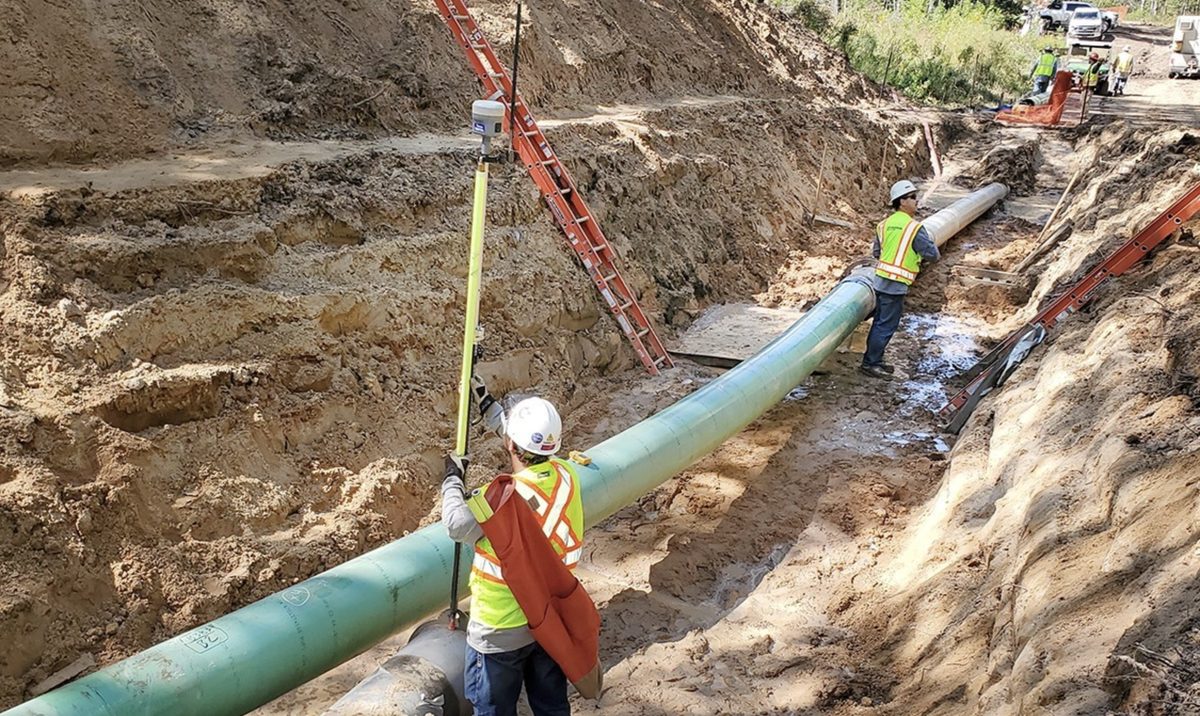
Quick answer
Minimum sewer gradient for pre-dimensioning follows the 1-in-DN rule (Maguire's Rule): slope ≈ 1:DN, so a DN200 gravity sewer needs about 1:200 (0.5%, 5 mm/m) and a DN300 about 1:300 (0.33%, 3.3 mm/m) — gentler than the UK 1:40/1:80 private-drainage falls. It's a starting value, not a proof: the binding check is self-cleansing velocity (around 0.7 m/s) at the design flow under EN 752.
Note: The table below is a rule of thumb for pre-dimensioning a gravity public sewer (gravity main), not a verification and not private-drainage guidance. Binding values come from the hydraulic check and the current edition of the relevant standard (EN 752, EN 1610, Sewers for Adoption / Ten State Standards, or your local code) and the network operator's requirements.
Need a quick figure for the minimum gradient of a sewer reach? The 1-in-DN rule — known in the UK as Maguire's Rule — gives a starting value per diameter. The table below works it out for the usual public-sewer sizes and shows it three ways — as a 1:DN ratio, in % and in mm/m (the metric form some standards write as ‰) — so it reads the same whichever convention you use. Then it explains how this differs from the private-drainage falls you may know (UK 1:40 / 1:80) and when the rule of thumb is not enough.
Minimum gradient by DN (1-in-DN / Maguire's Rule)
| DN (mm) | Gradient 1:DN | % | mm/m | ≈ cm / 100 m |
|---|---|---|---|---|
| 100 | 1:100 | 1.0 | 10 | 100 |
| 125 | 1:125 | 0.8 | 8 | 80 |
| 150 | 1:150 | 0.67 | 6.7 | 67 |
| 200 | 1:200 | 0.5 | 5 | 50 |
| 250 | 1:250 | 0.4 | 4 | 40 |
| 300 | 1:300 | 0.33 | 3.3 | 33 |
| 400 | 1:400 | 0.25 | 2.5 | 25 |
| 500 | 1:500 | 0.2 | 2 | 20 |
| 600 | 1:600 | 0.17 | 1.7 | 17 |
How it is computed: the 1-in-DN gradient is 1:DN, i.e. ≈ 100 ÷ DN as a percent (mm in the DN). DN200 → 1:200 = 0.5 % = 5 mm/m = 50 cm of fall per 100 m.
Private drainage vs public sewers — don't mix them up
If you know the 1:40 and 1:80 falls, those are private / building drainage within the plot (UK Approved Document H): roughly 1:40 for ~100 mm and 1:80 for ~150 mm pipes carrying small flows. They are deliberately steep because those runs rarely flow full.
Public sewers — the gravity mains a designer lays out on a long section, DN150 and up — use the gentler 1-in-DN values above, because larger pipes reach self-cleansing velocity at a smaller gradient. Public-sewer practice (UK Sewers for Adoption, US Ten State Standards) allows these flatter grades as DN increases; applying a 1:80 fall to a DN400 trunk sewer would bury it needlessly deep. Use the table for public-sewer design; keep 1:40/1:80 for drainage within the building or plot.
When the rule is enough — and when it is not
The 1-in-DN rule is a sanity check and a starting value, not a verifiable proof. What governs the minimum is not "slope for flow" but slope for self-cleansing: the flow must be fast enough to carry solids rather than let them settle.
- The check is to choose the gradient so the minimum self-cleansing velocity is reached at the design flow — on the order of 0.7 m/s (≈ 2.3 ft/s) at partial fill; US codes set an absolute floor around 2.0 ft/s (~0.6 m/s). Confirm against EN 752 / your local code. For larger or critical reaches, the reviewer expects this check, not the rule of thumb.
- Maximum gradient: a single hard maximum is rare, but above ~3 m/s (conservative, concrete; modern plastics tolerate more) abrasion and air entrainment become design topics. Instead of running a reach steep throughout, a drop structure in the manhole is often cleaner.
- Service connections have their own, steeper requirement — don't read them off this public-sewer table.
The flatter the reach, the more sensitive it is to construction tolerance: a few centimetres of invert error over a long reach cancels out a small design gradient.
The logic behind these values — velocity, self-cleansing, minimum and maximum gradient — is covered in gravity sewer gradients.
Frequently asked questions
What is the minimum slope for a sewer pipe by diameter? For pre-dimensioning a gravity public sewer, use the 1-in-DN rule: minimum gradient is roughly 1:DN. A DN150 sewer is about 1:150 (0.67%, 6.7 mm/m), a DN200 about 1:200 (0.5%, 5 mm/m), a DN300 about 1:300 (0.33%, 3.3 mm/m) and a DN400 about 1:400 (0.25%, 2.5 mm/m). It's a starting value, not a verified proof — the binding check is self-cleansing velocity at the design flow.
What is Maguire's Rule for sewer gradient? Maguire's Rule is the UK name for the 1-in-DN rule of thumb: the minimum gradient of a gravity sewer is about 1 divided by the pipe diameter in millimetres. So a DN225 sewer gets roughly a 1:225 fall. It works because larger pipes reach self-cleansing velocity at a smaller gradient, which is why public-sewer grades get gentler as diameter increases.
Why is the sewer slope different from the 1:40 and 1:80 falls? The 1:40 and 1:80 falls are private or building drainage within the plot, under UK Approved Document H: roughly 1:40 for about 100 mm pipes and 1:80 for about 150 mm, deliberately steep because those short runs rarely flow full. Public sewers, the gravity mains laid out on a long section, use the gentler 1-in-DN values, because applying a 1:80 fall to a DN400 trunk sewer would bury it needlessly deep.
Is the 1-in-DN table enough to prove a sewer gradient? No — the 1-in-DN rule is a sanity check and a starting value, not a verifiable proof. What governs the minimum is slope for self-cleansing: the flow must be fast enough to carry solids rather than let them settle. The binding check is choosing the gradient so the minimum self-cleansing velocity, on the order of 0.7 m/s, is reached at the design flow. Confirm against EN 752 or your local code.
Rather than read a gradient off the table and work the levels out by hand, the free pipe slope and invert level calculator solves any one of upstream invert, downstream invert, reach length and gradient from the other three, shows the result as 1:n, %, ‰ and mm/m at once, and draws a live long section from a pasted manhole schedule.
What it means for the long section
Choosing the gradient is only half the work; the other half is showing it correctly. In the longitudinal profile, each reach's sewer slope must be consistent with its length, the invert level resolved at every manhole, and the cover checked along the whole route. How that becomes a clean, deliverable DXF is shown in Altivo step by step.
Try Altivo for free — in the browser, no CAD, 14 days without a card.
Related articles
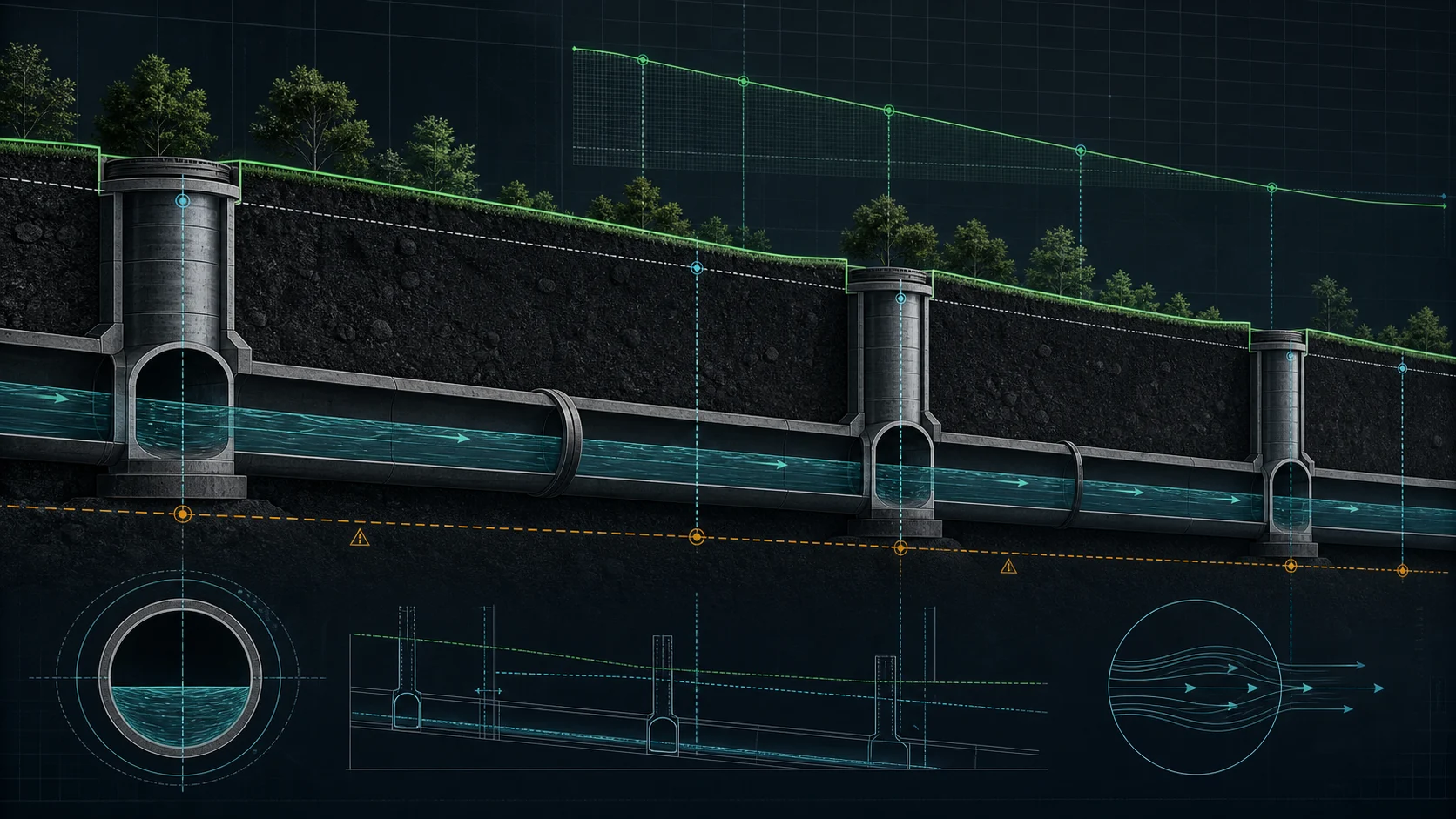
Gravity sewer gradients in the UK: minimum and maximum slopes — BS EN 752 and Sewerage Sector Guidance
How to choose the slope of a gravity sewer in the UK: self-cleansing velocity, the 1/DN rule of thumb, minimum and maximum gradients, and which framework applies (BS EN 752 and the sewerage undertaker's DCG for public sewers; Building Regulations Part H for building drainage).
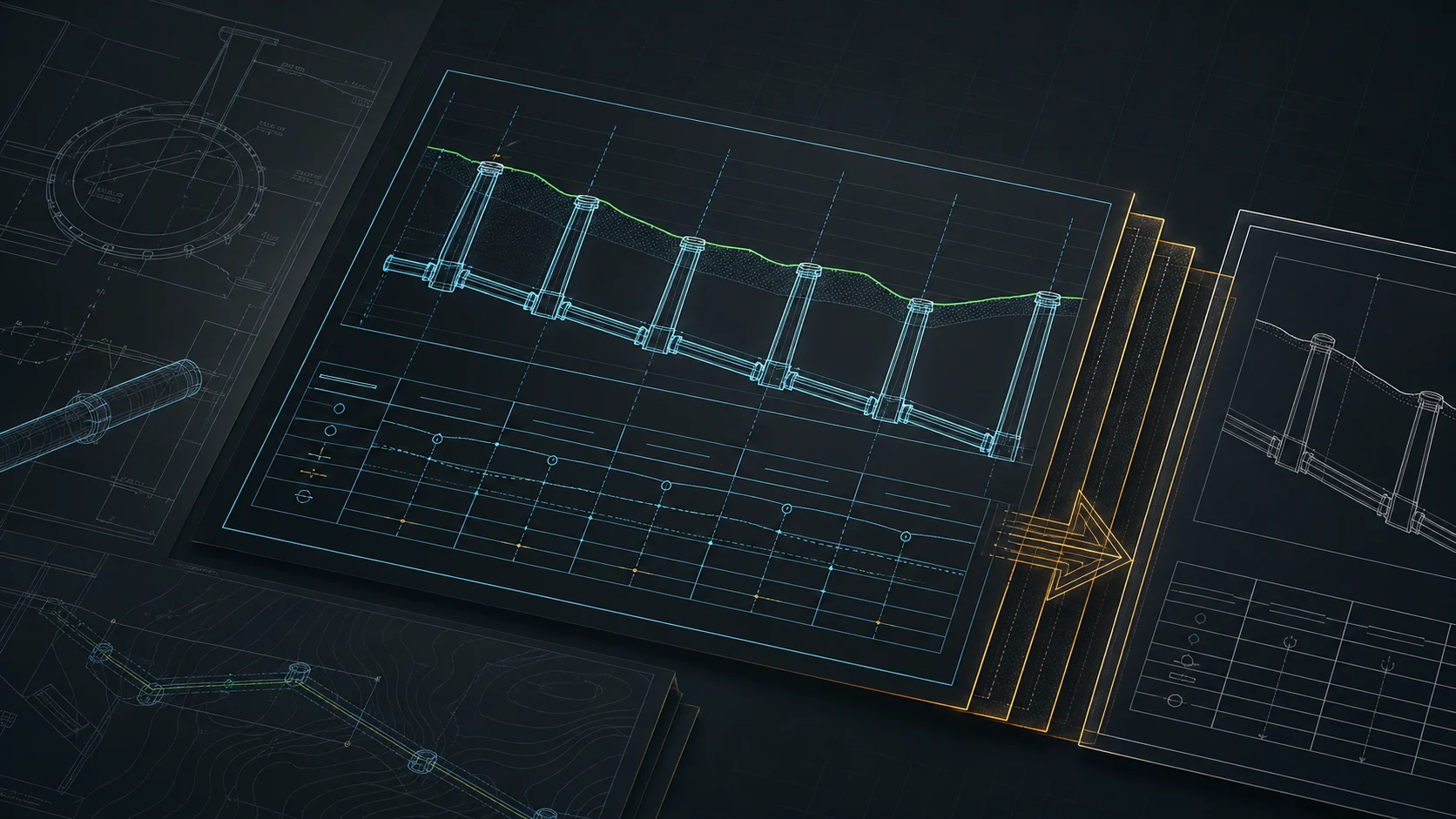
Sewer long section to DXF — step by step
From field coordinates to a CAD-ready longitudinal profile of a gravity sewer. A concrete walkthrough: import, gradients, manholes, drop connections, dual-scale DXF export.

Import Coordinates from Excel into AutoCAD: CSV, Point IDs and Elevations
Get a survey point list from Excel into CAD without losing point IDs, decimals or elevations: prepare the CSV, map easting, northing and Z, and compare plain AutoCAD with Civil 3D point file formats (PNEZD vs PENZD) — with a sample file.
Easting and Northing: British National Grid, ITM and US State Plane in CAD
How to read an easting/northing pair, OS grid references, OSGB36 vs WGS84 and OSTN15, Irish Grid vs ITM, US State Plane zones and the survey-foot trap — worked numbers and a troubleshooting table for a drawing that lands somewhere else.
Ready to design without the pain?
Altivo is the fastest way to produce a clean DXF. Try it today.
Start the 14-day trial